Strategic Planning Facilitation
We combine expert facilitators with a proven strategic planning methodology, the Drivers Model, to make sure your energy and time that goes into building a quality plan pays off.
How Strategic Planning Works
Why You Need a Strategy
Taking the time to develop strategy is not only necessary, but critical to the long-term success and health of your organization. Accept it – you need a plan to thrive in today’s business economy whether you’re a corporation, a non-profit, or a government agency. Uncover other critical reasons to develop your organization’s strategy today.
How to Choose Your Facilitator
Strategic planning is a big task. Our clients often tell us that strategic planning is so challenging and so vital, that it cannot afford to be depended on by the participants themselves to lead. Get the right help. Professional facilitators will guide the group to excel as a team in the process.
You: The Drivers Model
The Drivers Model, Leadership Strategies’ strategic planning methodology, provides an approach that is elegantly simple yet robust and comprehensive enough to serve both a multi-billion-dollar corporation and a small, non-profit organization. Our methodology is fully scalable to meet your organization’s structure and size. Through our organized, three-phased approach, strategic planning will not be such a daunting task.
Your Strategy Document: What it Looks Like
Whether you’re executing a long-term strategy process or simply holding a two-day planning retreat, the Drivers Model provides you with five primary deliverables that are critical to the successful implementation of your plan.

Why do teams typically need shared strategies?
To Set Direction and Priorities
Having competing priority initiatives typically translates to wasted opportunity; define your organization’s view of success and related priorities that will drive desired outcomes
To Create Team Alignment
Different departments working to achieve separate organizational aims is counterproductive; get everyone moving together towards a common destination
To Simplify Decision-Making
Leaders oftentimes have trouble saying “no” to new ideas or potential initiatives; having clear and agreed upon priorities make it easier to remain focused
To Communicate the Message
When leaders walk around with virtual strategies locked in their heads, few people act on them; allow staff, suppliers, and even customers to help your organization reach its potential
The Drivers Model
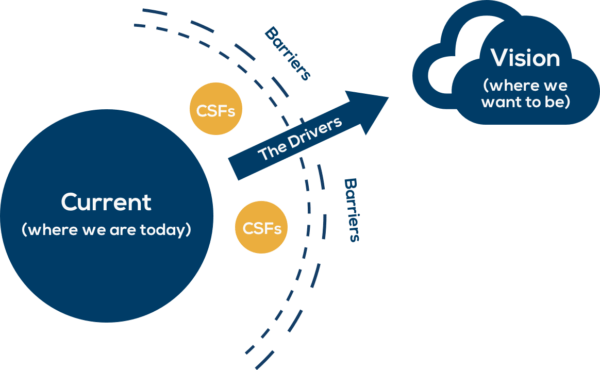
Simple, yet robust, The Drivers Model is our proven methodology for helping teams identify the core issues and construct effective strategies for solving them. Completely scalable to the strategy development needs of Fortune 500 companies, non-profit organizations, government agencies, small departments, and more.
4 Phases to Facilitating Strategy
The Management Briefing
In undertaking a strategic planning effort, have you ever found the team arguing over definitions, or wanting to complete the strategic plan in a half-day or a day, or disinterested because they don’t see how strategic planning will have impact on their day-to-day?
At Leadership Strategies we believe many of these issues can be resolved quickly up-front by holding a carefully crafted management briefing. Through the briefing, you are seeking to achieve the following:
- Commitment from senior management to take the time needed to develop and execute the plan.
- Identification of the critical issues to be addressed by the plan.
- A clearly defined and agreed to planning process tied to addressing the issues.
- A plan for gathering information about the current situation, including past plans, current initiatives, customer perceptions, employee opinions, industry trends and the competitive landscape.
We have developed the “Management Briefing on Strategic Planning” specifically to assist executives build the foundation needed for successful strategic planning.
The management briefing is a 90-minute interactive session, in which the planning team becomes laser-focused on the important issues impacting the organization.
Benefits of a Management Briefing
There are several benefits to the management briefing.
- Your planning team will walk away with a common view of the issues to be addressed.
- They will have determined what modifications might be needed to the standard planning approach to ensure that their issues are fully addressed.
- They will have agreed on a set of strategy definitions.
- They will have begun identifying the information they need to gather to make the planning session highly productive.
- They will have assigned responsibilities for ensuring that the key information is gathered and that the necessary steps are taken to prepare for the retreat.
- Most executive teams walk away with increased buy-in and commitment to participate in the planning effort and follow through on actions.
If successful, the management briefing will provide a strong foundation for launching the strategic planning activities.
Management Briefing Agenda
The agenda for the Management Briefing typically includes the following:
Getting Started
- Review the purpose and outcomes for the briefing.
Key Issues
- Use brainstorming and grouping techniques to get the participants to identify the most important issues facing the organization
A Standard Strategic Planning Approach
- Describe your approach for strategic planning; be sure to use an example that makes clear the definitions of the different components.
Modifying the Approach
- Have the participants link the issues to the approach.
- Ask participants to identify strengths and concerns about the approach.
- Agree upon adjustments to ensure the approach addresses the key issues as needed.
Situation Assessment
- Determine the information that should be gathered and distributed in advanced to ensure all members of the planning team start with a common foundation of information about the organization’s performance, customers, employees, industry, and competitors.
Logistics
- Define key information about the planning process, including the when, where, who, and how of the planning retreat.
Next Steps
- Identify the immediate next steps following the meeting.
Phase II: Assessment
Understanding the current situation is vital to identifying the approaches needed to drive success. A full understanding of the current situation includes an analysis of several areas. The list below shows a sample list of assessment areas and one or two of the key questions to be answered for each.
- Customers – What are their current and future needs? What are their perceptions of our performance?
- Employees – What are their perceptions of our organization and how we can improve? How can we make them more effective in their roles?
- Industry trends – What have been recent shifts in the industry? What shifts are anticipated for the future?
- Competitors – How do we compare against our competitors? What are their recent and anticipated initiatives?
- Performance trends – How are we performing by product, by market, by channel?
- Recent goals and initiatives – How are we achieving against our plan? How successful have we been with recent initiatives?
- Organization profile – What are our strengths and areas for improvement with regard to our organization structure, processes, technology, culture, etc.?
Often, planning teams summarize the current situation information into a SWOT: a summary of the organizations key strengths, weaknesses, opportunities and threats
Phase III: Strategy Sessions
The heart of strategic direction setting is this second step. In our Drivers Model, the information from the situation assessment is combined with the understanding of future trends to develop the vision statement and the mission statement.
- Vision – the organization’s preferred picture of the future
- Mission– the overall purpose of the organization (i.e., what the organization does, for whom it does it, and the benefit)
Click here for a sample segment of the strategic plan for a trade association of meeting planners. While the mission speaks to “what they do, for whom, and the benefit,” the vision describes what the future will look like if the organization achieves its mission.
The strategic direction setting also includes the defining of goals and objectives.
- Goals– the broad, long-term aims that define accomplishment of the mission
- Objectives – specific, quantifiable, realistic targets that measure the accomplishment of a goal over a specified period of time.
Each goal has a specific set of objectives, as shown below for the membership goal.
The objectives establish the bar for the rest of the planning effort. All the strategies, action plans and investments should be focused on achieving one or more of the plan objectives. Therefore, it is critical that you select the right objectives for measuring our success. Establishing objectives is perhaps the toughest work in planning.
The planning effort also includes establishing Guiding Principles – general guidelines that set the foundation for how the organization will operate. Guiding principles are more than just a statement of values. Guiding principles also describe the actions the organization will take based on the values
How do we plan to get there?
Once the objectives are established, the next step is to develop the road map for achieving the direction. For the road map to be viable, however, it must focus on three areas in particular.
Critical Success Factors
- Dynamic presenters with timely, substantive topics to increase meeting attendance
- High awareness of association by meeting planners to attract new members
Barriers
- Inadequate process for getting new members involved results in burn-out of a few and low retention
- High membership turnover hinders consistent growth
- The barriers to achieving the goals and objectives indicate those challenges which the organization must overcome to achieve its strategic direction. Barriers answer the following questions: “Why haven’t we achieved our goals already? What is standing in our way?”
- While barriers address the challenges, the critical success factors identify those key conditions that must be met to achieve the goals. Critical success factors, typically no fewer than two and no more than seven per goal, serve as a guide for determining the strategies to be developed.
- The strategies that are undertaken (i.e., the road map) must drive achievement of the strategic direction by controlling the critical success factors and overcoming the barriers.
An important activity at this stage is the prioritization of strategies to determine the items to focus on first. For each priority strategy, an action plan is developed which details steps, responsibilities, costs and timetables. The action plans can then be summarized to identify resource requirements and to develop a resource plan to meet those requirements.
Phase IV: Action Planning
During Phase III, an organization will likely identify 6-12 significant strategic priorities or initiatives that combine to move the organization in a specific strategic direction. For each of these priority initiatives, we recommend developing detailed action plans to ensure each of the initiatives are brought to completion.
A comprehensive action plan details the objectives to be achieved, deliverables, steps, responsibilities, costs, and timetables. Action plans have several advantages:
- The organization can confirm that the resources required to implement the strategy are worth the benefit gained.
- The deliverables and steps define for the implementation team when the initiative is completed.
- The organization has a road map for monitoring progress in accomplishing the initiative.
- All action plans can be summarized to identify resource requirements and to develop a resource plan to meet those requirements.
To ensure that you have written a solid action plan, we then implement the following quality:
- If all the actions are done, will the deliverables be created and the strategy be completed? If not, additional actions are needed.
- Have you identified the person responsible and the due date for each action? Without accountability, it will be very easy for the strategy to stall.
- Is each action step a clear activity? For example, “analyze survey results” is vague. When is the activity done? Better actions would be “Prepare survey report” or “Develop recommendations from survey results.”
“Enlisting Leadership Strategies helped my HR colleagues to find synergy: one team–one strategy! The Drivers Model was very easy to comprehend and apply, and I’m confident that the Leadership Strategies approach and expert facilitation has set the stage for a “NexGen” Penn State Health HR Organization!”
~Michelle D., MPA Director,Learning & Leadership Development PennState Health